
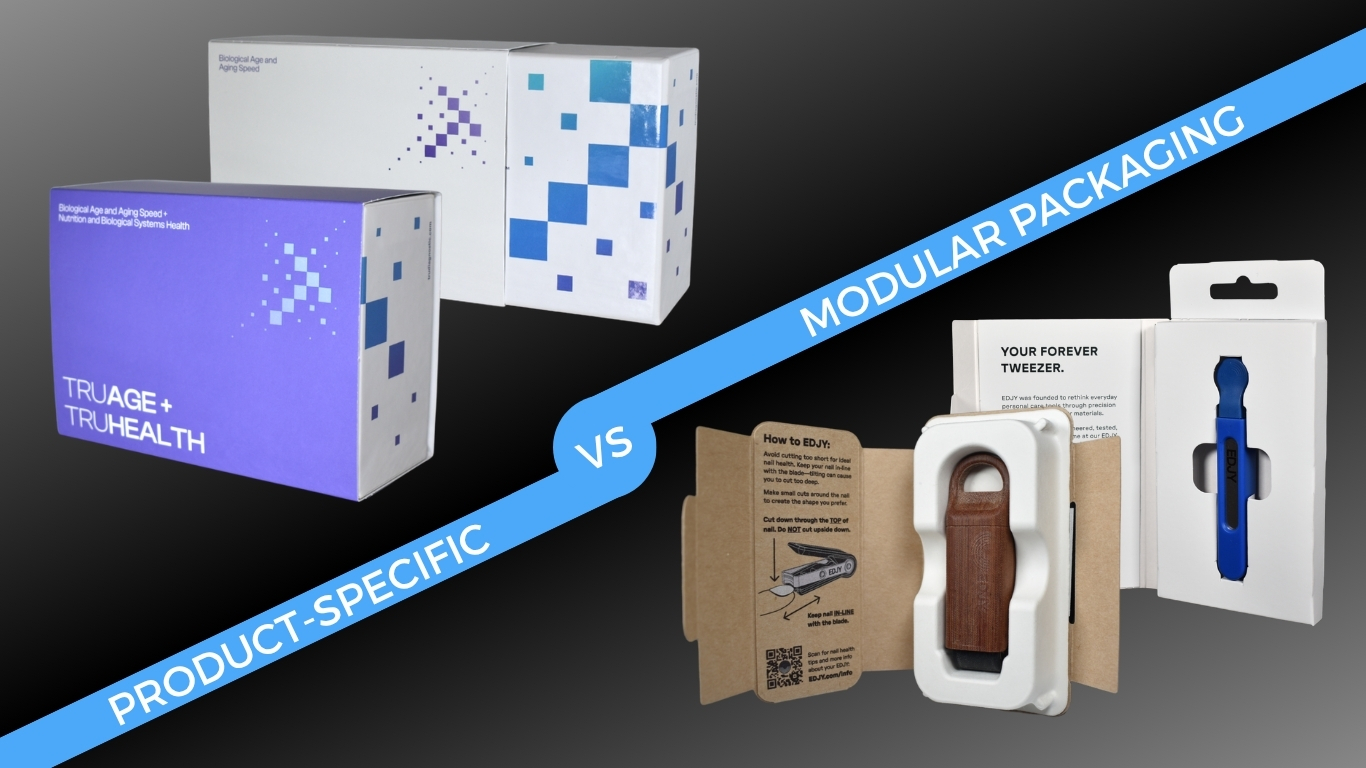
When managing packaging for multiple products or SKUs, one of the key decisions is whether to use a standardized packaging structure across several products or develop a unique package for each one.
Modular packaging can help reduce upfront costs by allowing multiple products to share the same packaging dimensions and structural design. However, that flexibility can come at the expense of material efficiency, as smaller products may be packaged in structures that are larger than necessary.
Product-specific packaging takes the opposite approach, with each package designed around the dimensions and requirements of the product it holds. While this typically requires a greater upfront investment in design and tooling, it can reduce material usage, minimize empty space, and improve shipping efficiency.
Choosing the right approach depends on your product assortment, order volumes, shipping requirements, and long-term packaging goals.
What Is Modular Packaging?
Modular packaging uses a standardized structure or a limited number of package sizes to accommodate multiple products within a product line.
Rather than developing a unique package for every SKU, brands can use a common packaging design, sometimes with interchangeable inserts, partitions, or other internal components to accommodate differences in product size and shape.
For example, a company selling several sizes of personal care products might use the same outer package for multiple SKUs, changing only the internal insert or printed graphics to accommodate each product.

Benefits of Modular Packaging
Lower upfront design and tooling costs
One of the biggest advantages of modular packaging is the ability to spread design and tooling investments across multiple products. Instead of developing a separate structure for every SKU, several products can share the same packaging design.
Simplified packaging inventory
Standardizing package sizes can reduce the number of unique packaging components a company needs to purchase, store, and manage. This can be particularly beneficial for companies with large product portfolios or frequently changing assortments.
Greater flexibility for new product launches
When new products are introduced, an existing modular packaging structure may be adaptable without requiring a completely new design. This can reduce development time and upfront costs.
Opportunities to consolidate order volumes
Combining packaging requirements across multiple SKUs may allow companies to order larger quantities of a common packaging structure, potentially improving purchasing efficiency and reducing per-unit manufacturing costs.
Limitations of Modular Packaging
The primary tradeoff with modular packaging is that a standardized structure cannot be perfectly sized for every product.
When a smaller product is placed in packaging designed to accommodate larger items, the package may contain unnecessary empty space. Depending on the design, additional inserts or supports may also be needed to keep the product secure.
This can create several considerations:
- Increased material usage: Larger packages may require more material than a product-specific alternative.
- Shipping inefficiencies: Oversized packaging can take up more space during transportation and storage, potentially increasing logistics costs.
- Additional internal components: Inserts, partitions, or other supports may be necessary to accommodate products of different sizes.
- Design limitations: A shared structure may not provide the same level of product presentation or functionality as packaging engineered for a specific item.
While modular packaging can offer significant upfront savings, these ongoing material and logistics costs should be considered when evaluating its long-term value.
What Is Product-Specific Packaging?
Product-specific packaging is designed around the dimensions, shape, weight, and functional requirements of an individual product.
Unlike modular packaging, which prioritizes standardization across multiple SKUs, product-specific packaging prioritizes optimizing the structure for a particular item.
This approach gives packaging engineers greater flexibility to determine the appropriate dimensions, internal supports, opening features, and material specifications for each product.
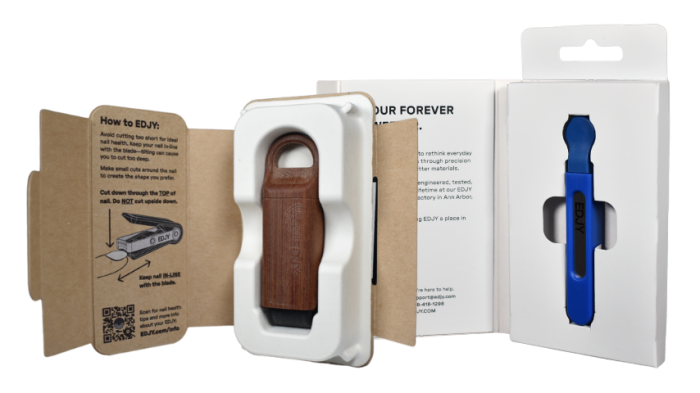
For example, a brand offering several different sizes of fragrance bottles might develop a unique package for each bottle. By designing each structure around the dimensions of its corresponding product, the brand can minimize unused space while maintaining a consistent visual identity across the product line.
Benefits of Product-Specific Packaging
Reduced material usage
By designing packaging around the dimensions of a specific product, packaging engineers can eliminate unnecessary space and potentially reduce the amount of material required. Over large production volumes, even small reductions in package dimensions can create meaningful material savings.
Improved shipping and storage efficiency
Right-sized packaging can allow more finished packages to fit into shipping cases, on pallets, and within warehouse storage areas. These efficiencies can become especially valuable for high-volume products that move through distribution networks regularly.
Optimized product protection
Product-specific structures can incorporate integrated supports, partitions, or other features designed around the product’s exact shape and weight. This can reduce movement inside the package and, in some applications, eliminate the need for separate protective components.
Greater structural design flexibility
A dedicated package allows designers to develop features tailored to the product and its intended use, including unique opening experiences, retail display features, and product presentation.
Limitations of Product-Specific Packaging
The biggest consideration with product-specific packaging is the additional upfront investment.
Each unique structure typically requires its own design development, prototypes, and production tooling. For companies managing many SKUs, those costs can add up.
Product-specific packaging can also increase inventory complexity, as each product requires its own packaging components.
For lower-volume products, the material savings achieved through a right-sized design may not be enough to offset the additional tooling and development costs.
| Consideration | Modular Packaging | Product-Specific Packaging |
|---|---|---|
| Upfront design and tooling costs | Generally lower when structures are shared | Generally higher with unique designs |
| Material efficiency | May use more material for smaller products | Can be optimized for each product |
| Shipping efficiency | May create additional empty space | Can minimize unused space |
| Packaging inventory | Fewer unique structures to manage | More unique packaging components |
| Flexibility across SKUs | High | Limited to the intended product |
| Product protection | May require interchangeable inserts | Can incorporate tailored supports |
| Best suited for | Diverse product lines, lower volumes, and changing assortments | Higher-volume, established products with consistent specifications |
When Does Modular Packaging Make More Sense?
Modular packaging is often a good choice when a company has a wide variety of products with relatively low individual order volumes.
For example, a brand with 20 different SKUs may find it difficult to justify the cost of developing 20 unique packaging structures, particularly if some products sell in relatively small quantities.
By grouping products into a few standardized package sizes, the brand can reduce the number of unique tools and structures required.
Modular packaging may also be beneficial when:
- Products have similar dimensions and protection requirements.
- New SKUs are introduced frequently.
- Packaging inventory needs to remain flexible.
In these situations, the savings from standardization may outweigh the additional material and shipping costs associated with less precisely sized packaging.
When Is Product-Specific Packaging Worth the Investment?
Product-specific packaging becomes increasingly attractive as production volumes grow.
At higher volumes, the additional cost of developing a dedicated structure can be spread across a larger number of units. Meanwhile, the savings associated with reduced material usage and improved shipping efficiency continue to accumulate with every production run.
Consider a product that ships hundreds of thousands of units annually. Even a small reduction in packaging dimensions could reduce material consumption and allow more units to fit into each shipping case.
Over time, those recurring savings may exceed the initial cost of developing and tooling a product-specific package.
Product-specific packaging is often worth considering when:
- A product has consistent, predictable demand.
- Annual production volumes are high.
- Existing packaging contains significant unused space.
- The product requires specialized protection or presentation.
- Reducing material consumption is a packaging priority.
Finding the Right Balance: A Hybrid Packaging Strategy
Choosing between modular and product-specific packaging doesn’t necessarily have to be an all-or-nothing decision.
For many companies, a hybrid approach offers an effective balance between upfront investment and long-term efficiency.
For example, a brand might use product-specific packaging for its highest-volume products while maintaining a small family of modular package sizes for lower-volume SKUs.
Another option is to group products by similar dimensions and develop a shared packaging structure for each group rather than using one universal package across the entire product line.
This approach allows companies to standardize where it makes financial sense while still taking advantage of right-sized packaging for products with sufficient volume.
How to Evaluate the Total Cost of Your Packaging Strategy
One of the most important considerations when comparing modular and product-specific packaging is looking beyond the initial price of the package.
A modular design may have a lower upfront tooling cost, but a product-specific design may offer savings throughout its production and distribution lifecycle.
A complete cost comparison should consider:
- Design and tooling: How much will it cost to develop and tool each unique structure?
- Packaging materials: How much material and how many additional components does each design require?
- Production volumes: How many units of each SKU will be produced annually?
- Pack-out efficiency: Will either structure require additional assembly steps or handling?
- Shipping and storage: How will package dimensions affect case counts, pallet configurations, and warehouse space?
- Inventory management: How many unique packaging components will need to be purchased, stored, and tracked?
Evaluating these costs together provides a more accurate picture of which approach offers the greatest value over time.
Choosing the Right Packaging Approach for Your Product Line
The decision between modular and product-specific packaging ultimately comes down to balancing flexibility, upfront investment, and ongoing efficiency.
Modular packaging can be an effective way to control tooling costs and simplify packaging programs across multiple SKUs. Product-specific packaging offers opportunities to reduce material usage, improve shipping efficiency, and optimize the package around the product itself.
For many brands, the most cost-effective solution may involve a combination of both.
At Wynalda Packaging, our structural design team works with customers to evaluate packaging requirements, identify opportunities for standardization or right-sizing, and develop structures that support both manufacturing efficiency and long-term packaging performance.
Looking to optimize packaging across your product line? Contact our team to explore the right approach for your products.