
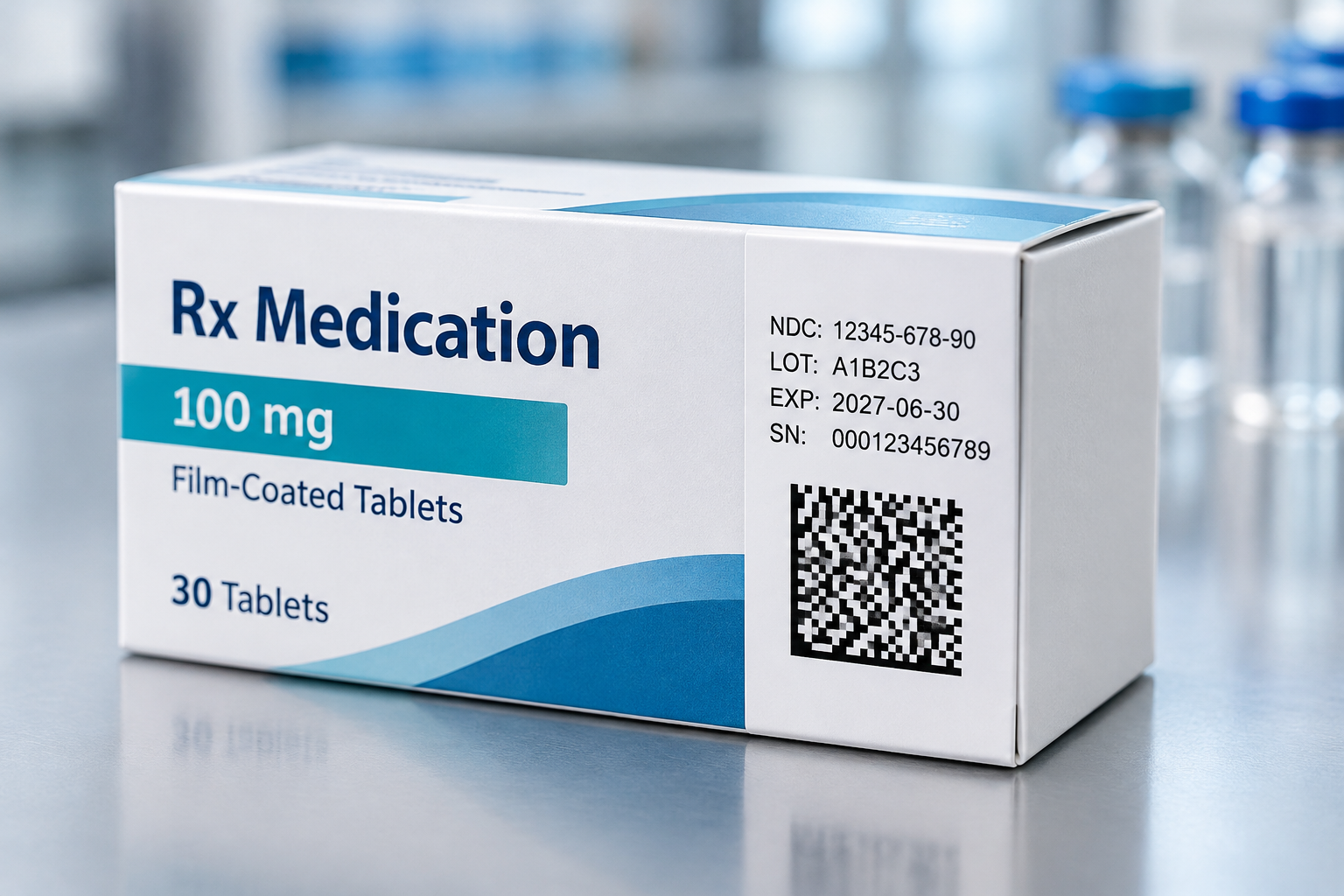
In the pharmaceutical industry, traceability is essential for protecting patients, maintaining supply chain security, and meeting regulatory requirements. As medications move from manufacturers through distributors, pharmacies, and healthcare facilities, the ability to identify and trace individual packages helps prevent counterfeit, stolen, or otherwise illegitimate products from reaching patients.
Track-and-trace systems make this possible by combining unique product identifiers, machine-readable barcodes, and electronic data exchange to provide visibility throughout the pharmaceutical supply chain.
For pharmaceutical manufacturers, implementing track and trace requires more than generating serial numbers. Packaging must carry accurate, readable identification codes that can be reliably scanned and verified as products move through production and distribution.
Understanding the technologies, printing processes, and regulatory requirements behind pharmaceutical track-and-trace packaging is an important part of developing an effective traceability program.
What Is Track-and-Trace?
Track and trace refers to the systems and processes used to identify, monitor, and trace products as they move through the supply chain.
Although the terms are often used together, tracking and tracing serve slightly different purposes:
- Tracking follows a product’s movement forward through the supply chain, from manufacturing to distribution and delivery.
- Tracing involves identifying a product’s history and previous movements, helping determine where it originated and where it has been.
Pharmaceutical track-and-trace systems rely on serialization, which assigns a unique identifier to each individual saleable package.
These identifiers are typically encoded in machine-readable 2D barcodes and associated with electronic records. When scanned, they allow authorized supply chain participants to identify products, verify information, and support investigations when necessary.
What Information Is Included in a Pharmaceutical Product Identifier?
Under the U.S. Drug Supply Chain Security Act (DSCSA), the standardized product identifier for covered prescription drug packages includes:
- National Drug Code (NDC): Identifies the drug product.
- Serial number: Distinguishes an individual package from other packages of the same product.
- Lot or batch number: Identifies the manufacturing batch.
- Expiration date: Indicates the product’s expiration.
These elements work together to support package-level identification and verification throughout the supply chain.
Why Is Track and Trace Important for Pharmaceutical Packaging?
Pharmaceutical products pass through multiple organizations before reaching the end user. Without reliable identification and traceability systems, it can be difficult to verify product authenticity, investigate supply chain discrepancies, or identify affected products during a recall.
Track-and-trace technologies help address these challenges in several ways.
Protecting Against Counterfeit and Illegitimate Products
Unique product identifiers allow trading partners to verify information associated with individual pharmaceutical packages.
When a product is suspected of being counterfeit, diverted, stolen, or otherwise illegitimate, serialization and electronic traceability records support the investigation and verification process.
Supporting More Targeted Recalls
Lot numbers and serial numbers help manufacturers and supply chain partners identify affected products when a quality or safety issue arises.
By connecting package-level identifiers with manufacturing and distribution records, track-and-trace systems can help organizations locate affected inventory and coordinate recall activities more effectively.
Improving Supply Chain Visibility
Track-and-trace systems support the exchange of product identification and transaction information between authorized trading partners.
This information can help pharmaceutical companies investigate discrepancies, verify product movements, and maintain more reliable records throughout distribution.
Meeting Regulatory Requirements
In the United States, the DSCSA establishes requirements intended to create a more secure, interoperable prescription drug supply chain.
For manufacturers and other covered trading partners, meeting these requirements involves coordinating serialization, product identification, verification, and electronic data exchange.
The packaging itself plays an important role by carrying the machine-readable identifiers used within these systems.
Pharmaceutical Track-and-Trace Compliance Requirements
Pharmaceutical traceability involves several regulatory requirements, industry standards, and supporting technologies. Understanding the differences between them is important because not every standard or technology represents a separate legal requirement.
Drug Supply Chain Security Act (DSCSA)
The Drug Supply Chain Security Act, enacted in 2013, established a framework for tracing certain prescription drugs distributed within the United States.
The law directs the FDA to establish requirements for identifying and tracing covered pharmaceutical products as they move through the supply chain.
Key elements include:
- Package-level product identification using standardized identifiers.
- Product verification procedures.
- Electronic exchange of transaction information and transaction statements.
- Systems and processes for identifying and investigating suspect or illegitimate products.
- Traceability procedures among authorized trading partners.
DSCSA requirements apply to covered products and trading partners, with certain exemptions, exceptions, and implementation policies affecting specific circumstances.
For packaging operations, one of the most visible requirements is the standardized product identifier applied to each covered package.
GS1 DataMatrix Barcodes
GS1 DataMatrix is a widely used barcode format for pharmaceutical serialization.
Unlike traditional linear barcodes, which encode information along one dimension, a DataMatrix barcode stores information in a two-dimensional pattern of light and dark modules.
This allows multiple data elements to be encoded in a relatively compact area.
GS1 standards define how information such as product identifiers, serial numbers, lot numbers, and expiration dates can be represented using standardized Application Identifiers.
These standardized data structures support consistent interpretation of barcode information across compatible systems.
GS1 DataMatrix is an industry standard commonly used to support pharmaceutical traceability. It is important to distinguish GS1 formatting requirements from the specific obligations established by the FDA.
2D DataMatrix Barcodes vs. QR Codes
Both DataMatrix and QR codes are two-dimensional barcode technologies, but they serve different purposes in pharmaceutical packaging.
DataMatrix barcodes are commonly used for pharmaceutical serialization because they can encode standardized product identification information in a compact space.
QR codes are frequently used for consumer-facing applications, such as providing access to digital instructions, product information, or authentication services.
For covered U.S. prescription drug packages, the DSCSA specifies a 2D Data Matrix barcode for the required product identifier. A conventional QR code is not a substitute for that required barcode.
Pharmaceutical packaging may contain both types of codes when they serve different purposes. However, the required identification information must still be presented in the appropriate format.
Barcode Verification
A barcode must be readable for a track-and-trace system to function reliably.
Barcode verification evaluates characteristics such as:
- Symbol contrast
- Modulation
- Fixed-pattern damage
- Axial nonuniformity
- Grid nonuniformity
- Unused error correction
These measurements help determine whether a printed barcode meets an established quality grade.
Barcode verification is different from simply scanning a code. A barcode may scan successfully under favorable conditions while still having print-quality issues that affect readability on other equipment.
Vision Inspection Systems
Vision inspection systems are used in pharmaceutical packaging operations to check printed information and help identify errors before products continue through production.
Depending on the equipment and configuration, these systems may:
- Read and decode serialized barcodes.
- Confirm that printed information matches the expected data.
- Detect missing, damaged, or unreadable codes.
- Inspect human-readable text.
- Identify duplicate or incorrect identifiers when integrated with appropriate data systems.
- Trigger rejection or segregation of packages that fail inspection.
Vision inspection is an important supporting technology, but it does not independently establish DSCSA compliance. Effective traceability also depends on accurate data management, verification procedures, and the systems used to exchange information throughout the supply chain.
Key Technologies Used in Pharmaceutical Track-and-Trace Packaging
Regulatory requirements establish what information must be identified and exchanged, but the printing and inspection technologies used to produce pharmaceutical packaging determine how reliably that information can be applied and read.
Variable Data Printing
Variable data printing (VDP) allows information to change from one printed package to the next without requiring a new printing plate for each variation.
Traditional offset printing is well suited for producing large quantities of identical artwork. However, pharmaceutical serialization requires unique information on individual packages, making variable data capabilities particularly valuable.
Variable data printing can be used to apply:
- Unique serial numbers
- Serialized 2D DataMatrix barcodes
- Lot and batch identification
- Expiration dates
- Other product-specific identification information
For serialized pharmaceutical packaging, the printing process must also be coordinated with the systems responsible for generating, assigning, and managing unique identifiers.
Accurate data handling is just as important as print quality. Duplicate, missing, or incorrectly assigned serial numbers can create problems during downstream verification and distribution.
Digital Offset Printing: The Landa S11
One of the challenges of pharmaceutical track-and-trace packaging is combining variable data capabilities with the print quality and production efficiency needed for commercial packaging volumes.
Modern digital printing technology provides an opportunity to address this challenge. The Landa S11 uses Nanographic Printing technology to combine digital flexibility with the quality and productivity associated with conventional offset printing.
Unlike traditional offset processes that require printing plates, the Landa S11 prints directly from digital files. This allows variable information to be incorporated into a print job while maintaining consistent full-color graphics.
Key capabilities include:
- Variable data printing: Individual sheets can contain different information, supporting applications such as unique identification codes, serialization, and versioned packaging.
- High-quality graphics: Nanographic Printing technology supports detailed imagery, text, and color reproduction, allowing brands to maintain their visual identity alongside variable information.
- High-speed production: The Landa S11 has a rated printing speed of 6,500 sheets per hour.
These capabilities make the Landa S11 relevant to pharmaceutical packaging applications that require both high quality branding and variable identification information.
The Role of Packaging Manufacturers in Pharmaceutical Track and Trace
Effective pharmaceutical traceability requires coordination between drug manufacturers, packaging suppliers, serialization technology providers, and distribution partners. Each contributes to a different part of the process.
Pharmaceutical manufacturers are responsible for meeting applicable DSCSA obligations. Packaging manufacturers support those programs by producing packaging that can accommodate required product identification information and maintain the print quality needed for reliable scanning.
Depending on the production arrangement, this may involve supplying preprinted cartons, applying variable identification information, or coordinating with downstream serialization and inspection operations.
As track-and-trace requirements continue to shape pharmaceutical supply chains, the relationship between printing technology, data accuracy, and packaging quality becomes increasingly important.
Supporting Pharmaceutical Traceability Through Advanced Printing
At Wynalda Packaging, we understand the importance of print consistency, accuracy, and manufacturing efficiency in pharmaceutical packaging. Our team works with customers to evaluate their packaging requirements and develop solutions that support their production and identification needs.
Looking for a pharmaceutical packaging partner? Contact Wynalda Packaging to discuss your project.